
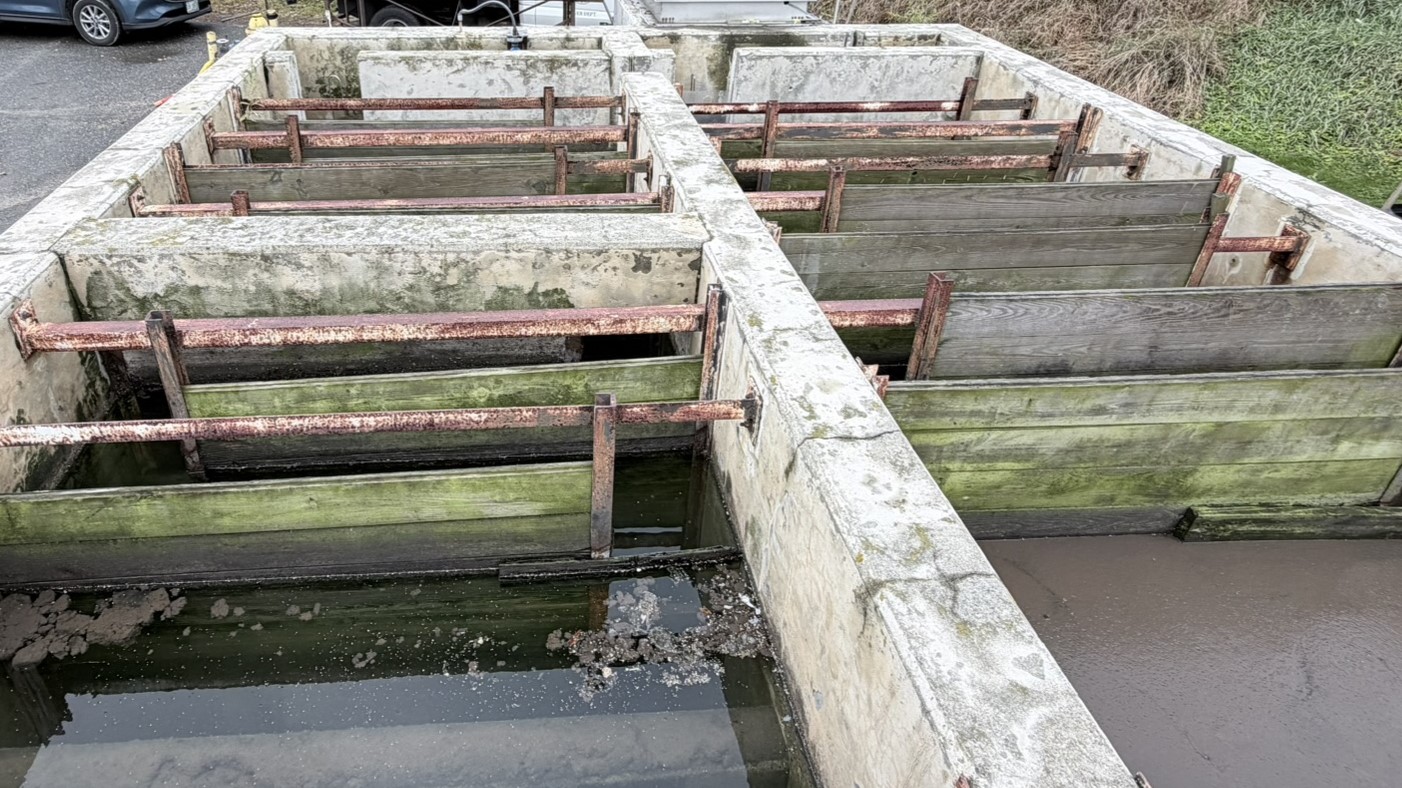
Wastewater treatment uses a lot of terms that are not used in everyday life or are not used in this particular context. Please see the table below for a non-exhaustive list of terms we commonly use when discussing wastewater treatment plants.
Aeration
The process by which we add oxygen to wastewater to support the growth of microorganisms. Microorganisms help us remove phosphorus and nitrogen without adding chemicals.
Aerobic Granular Sludge
A type of biological process with the goal of creating dense particles (granules) of sludge. These dense particles are even better at treating wastewater and require less chemicals and oxygen than traditional biological processes.
Biological Process
Refers to the use of microorganisms for removing harmful pollutants from wastewater.
Cake
The dry solids produced by the dewatering process.
Chemical Dose/Chemical Dosing
Refers to the amount of chemical added to the wastewater process and the equipment used to add the chemical.
Corroded
Refers to the breakdown of metal equipment from exposure to harsh environments.
Dewatering
Refers to the process by which we separate solids and liquid from sludge produced at the plant.
Discharge
Refers to the release of wastewater from a treatment plant.
Disinfection
Refers to the process we use to remove harmful bacteria, such as E. Coli, from wastewater. We commonly use chlorine or ultraviolet light for this process.
Influent
Untreated wastewater entering the plant in general, or partially treated wastewater as it leaves each of the specific processes.
Effluent

Treated wastewater that is discharged from the plant in general, or partially treated wastewater that is leaving each individual process on its way to the next process. For example, the effluent from the Biological Process is the influent of the UV system that follows it.
Flow
This is a term used to describe the amount of wastewater entering the facility per a certain amount of time. Most commonly we measure flow in Million Gallons per Day (MGD).
Grit
Solids such as sand or gravel that should not enter the wastewater treatment plant.
Headworks
Untreated wastewater entering the plant in general, or partially treated wastewater as it leaves each of the specific processes.
NPDES
National Pollutant Discharge Elimination System
Pump Station
A facility designed to convey wastewater from a low point to a higher point.
Redundancy
Refers to the process in which engineers design wastewater treatment plants with multiple of the same pieces of equipment so the plant can continue to run in the event of a failure.
Screening
Large items like sticks, wipes and plastic that should not enter a wastewater treatment plant.
Secondary Clarifiers
Large, usually circular, concrete tanks used to separate solids (sludge) from the rest of the wastewater.
Sludge or Biosolids
This term refers to the portion of wastewater that has a very high percentage of solids, it is separated from low-solids wastewater.